English
Choose dry back LVT when the project prioritizes a fully bonded installation and controlled movement under approved service conditions. Consider loose lay LVT flooring when access, local replacement or future layout changes are central to the brief. Neither system eliminates subfloor preparation, and loose lay does not automatically mean adhesive-free installation.
For contractors and distributors, the decision should follow the operating environment: foot traffic, wheeled loads, sunlight, substrate condition and available closure time. Compare complete installed systems rather than plank prices alone. UTOP offers both formats, allowing buyers to assess samples against the same project brief before committing to a specification or delivery programme.
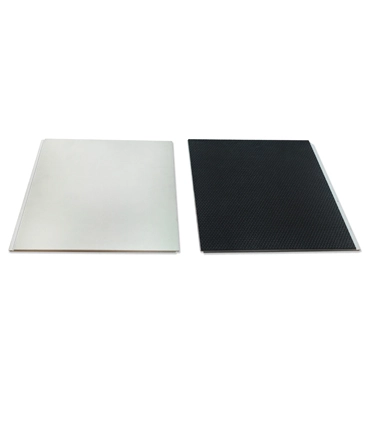
Dry back LVT uses full-spread adhesive, while loose lay LVT uses a purpose-designed backing with fixation specified for the application.
UTOP dry back LVT flooring is bonded to the substrate. Loose lay may still need perimeter, grid or full-area adhesive.
For example, Karndean’s loose lay installation guide specifies fixation by service conditions. This is an example, not a UTOP instruction; obtain requirements for your selected SKU.
| Project factor | Dry back LVT | Loose lay LVT |
|---|---|---|
| Fixing method | Full-spread adhesive | Product- and application-specific fixation |
| Programme | Allow for adhesive and traffic restrictions | Preparation and fixation still take time |
| Local repairs | Remove plank and prepare for rebonding | May allow easier lifting, depending on adhesive |
| Future access | Bond removal can complicate access | Coordinate lifting with the access-floor design |
| Budget | Include adhesive, preparation and labour | Include fixation, thickness and handling |
UTOP lists 2.5 mm dry back and 5.0 mm loose lay options, with 0.5 mm and 0.7 mm wear-layer options available in both ranges. These options do not establish commercial suitability on their own.
Commercial suitability matches flooring to expected traffic, loads and environmental conditions.
For permanent retail spaces or trolley routes, assess an approved glue-down system first. Confirm flooring and adhesive suitability for castors, turning forces and static loads; bonding alone does not guarantee performance.
For offices needing cable access or tenant changes, loose lay LVT flooring may aid maintenance. Coordinate plank layout, access-panel joints and fixation to preserve service access.
Assess entrances, circulation and workstation zones separately. Confirm fixation at thresholds and sun-exposed areas; one method may not suit every zone.
Subfloor readiness allows the flooring and adhesive system to perform as intended.
Both need a sound, smooth, clean and suitably dry base. Loose lay cannot correct unevenness. Thin dryback LVT can reveal irregularities; include preparation in both quotations.
For concrete, ASTM F710 addresses concrete preparation without superseding manufacturer instructions. Confirm flatness, contamination, moisture and pH requirements.
ASTM F2170 measures relative humidity inside concrete slabs; it does not set a universal acceptable RH limit for LVT. Compare results with the chosen system’s written limits.
Retain spare planks by batch. Dry back repairs require local adhesive preparation; loose lay replacement depends on fixation. Have the installer demonstrate removal and reinstatement before promising minimal downtime.
A project specification connects the SKU with site conditions, installation and acceptance requirements.
Request use, area, substrate report, rolling loads, sunlight exposure and handover date. Confirm thickness, wear layer, dimensional stability, fire/slip evidence and the SKU’s commercial warranty.
Compare flooring, preparation, moisture treatment, adhesive, labour, transitions, downtime and replacement costs. Avoid savings percentages without comparable quotations.
Confirm return-to-service times for foot traffic, furniture and wheels. Quick laying does not guarantee immediate reopening. Use a trial area to assess appearance, bonding and repairs.
LVT system selection balances service performance with access, programme and maintenance needs.
Choose an approved dry back system where permanent bonding serves the project. Consider loose lay where planned lifting or reconfiguration adds value, after confirming fixation requirements.
Explore UTOP’s LVT flooring range and request samples of both installation systems. Send the project type, area, substrate condition, traffic profile and deadline so UTOP can help compare suitable specifications.
LVT installation planning matches the flooring system to building operations.
No. Dry back LVT needs a separately specified adhesive. Self-adhesive flooring has a pre-applied adhesive backing.
It may. Confirm the selected product’s instructions for the traffic, room layout and environmental conditions.
Compare installed and maintenance costs, including preparation, fixation, labour and downtime.
Only over an approved, prepared substrate. Check tile adhesion, grout lines, moisture and floor height.
No. Assess wear layer, construction, test evidence and approved use separately from overall thickness.
Do not assume so. Follow written requirements for acclimatization, fixation and return to foot or wheeled traffic.
When choosing between rigid and flexible cores for a project, our SPC vs LVT wholesaler guide breaks down the trade-offs.
 EN