English
Today's wholesale flooring market has shifted toward waterproof, durable, and cost-effective PVC resilient flooring, with SPC Stone Plastic Composite and LVT Luxury Vinyl Tile as the dominant options.Their similar appearances often lead to misjudgment and blind purchasing, yet the two differ significantly in material, production technology, and application scenarios:SPC is more durable and dimensionally stable, ideal for high-traffic and humid commercial projects;LVT offers greater comfort and texture, better suited for residential and high-end interior applications.This guide breaks down their differences across four dimensions—material, performance, application scenarios, and wholesale recommendations—to help wholesalers make accurate product selections, align with customer demands, avoid pitfalls, and boost sales conversions and reputation.
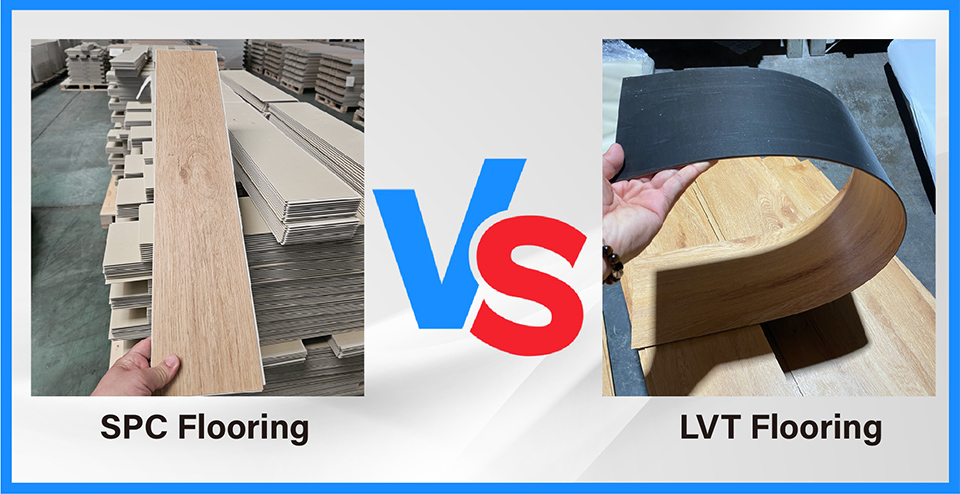
Composed of over 70% calcium carbonate powder and approximately 20% PVC, it is a high-density rigid board manufactured through an extrusion process.Its structure is straightforward: from top to bottom, it consists of a UV wear layer, a decorative film layer, and a rigid core substrate layer.For enhanced underfoot comfort, an additional sound-dampening underlayment can be installed, as the base material itself is firm and rigid.
Composed primarily of a high proportion of PVC with only a small amount of calcium carbonate added, it is a semi-rigid, flexible material produced using a hot-pressing process.Its structure includes an extra cushioning layer compared to SPC.Besides the top wear layer and decorative layer, it also features a middle core layer and a soft backing layer, providing inherent cushioning.It delivers good comfort without the need for an additional underlayment.
Comparison Dimension | SPC Flooring | LVT Flooring |
Hardness & Underfoot Comfort | High hardness and strong rigidity. Feels cool and hard underfoot with no elasticity; may feel uncomfortable when walking barefoot. | Semi-rigid with built-in elastic cushioning. Offers optimal softness, with a feel closer to solid wood, providing greater walking comfort. |
Water Resistance | Truly 100% waterproof. Will not warp or peel even when submerged in water. | Good for daily water resistance, but not suitable for long-term water immersion, which may cause damage over time. |
Dimensional Stability | Excellent stability with minimal thermal expansion and contraction. Will not arch or deform even under large temperature differences or with underfloor heating. | Good stability but inferior to SPC. Slightly higher risk of minor deformation under extreme temperature changes. |
Wear & Durability | High wear resistance, impact-resistant and pressure-resistant. Resists indentations and scratches from heavy furniture and high foot traffic. | Sufficient for daily wear, but prone to permanent indentations from heavy loads and scratches from sharp objects, which cannot be repaired. |
Sound Insulation | Average sound insulation. The rigid material produces noticeable footstep noise; a sound-dampening underlayment is required for improvement. | Built-in cushioning for effective sound insulation. Quieter for residential use, with no need for an additional underlayment. |
Standard Thickness | Mainstream thickness: 4–8mm, generally thicker with a more substantial feel. | Mainstream thickness: 2–5mm, generally thinner, resulting in less floor height difference after installation. |
Installation Method | Mostly click-lock system, glue-free, DIY-friendly, and quick to install. | Both click-lock and glue-down options available. Thin versions usually require glue-down installation, which is slightly more complicated. |
Price Range | Mid-to-high price range, slightly more expensive than LVT. | Mid-to-low price range, higher cost performance, ideal for budget-conscious projects. |
Texture Realism | Decent pattern simulation, but the rigid substrate limits deep 3D texture, resulting in slightly weaker realism. | Highly realistic texture. The flexible substrate enables deep embossing, making both wood and stone looks closer to natural materials. |
Choose virgin SPC flooring if you have wet areas such as kitchens, bathrooms, balconies, or basements.It is also highly recommended for high-traffic public spaces including shops, offices, schools, and hospitals.For homes with heavy furniture or home appliances that may damage flooring, as well as houses with underfloor heating, SPC’s superior stability and durability ensure reliable performance with minimal maintenance required.
LVT flooring is ideal choice for pure residential decoration, especially bedrooms, living rooms, and studies where comfort and quietness are preferred.It provides a safer surface for the elderly and children in case of falls, and offers excellent noise reduction. Additionally, LVT delivers outstanding visual appeal and cost-effectiveness for customers with limited budgets who want stylish, realistic floor textures.
SPC and LVT are not competing products but complementary categories. Wholesalers do not need to choose one over the other; instead, they should stock a mix based on local market demand.
If commercial projects, shops, or rental properties account for a large portion of your orders, focus on SPC and highlight its waterproofing, wear resistance, and easy installation for engineering projects.If your customers are mainly for residential, high-end decoration, and self-occupancy homes, emphasize LVT’s comfortable underfoot feeling, sound insulation, realistic textures, and cost performance.
When recommending products to clients, first clarify their application scenario, budget, and pain points before providing targeted solutions.This approach not only meets customer needs efficiently but also demonstrates professionalism, reduces decision-making difficulty, and minimizes after-sales disputes.By selecting the right products, stocking according to demand, and offering scenario-based recommendations, wholesalers can capture the full potential of the PVC flooring market, improve repeat orders and reputation, and ensure more market-aligned and profitable inventory distribution.
In a market driven by waterproofing, durability, and cost-effectiveness, SPC and LVT are indispensable complementary categories for wholesalers.Understanding the differences in materials and technology, identifying customer scenarios, budgets, and pain points, stocking accordingly, and providing scenario-based recommendations can effectively reduce inventory and after-sales risks while improving conversion rates and customer satisfaction.For more product selection strategies and purchasing solutions, please contact the UTOP professional consultant team.
 EN
EN